
Confusion around what segmentation is can make it feel impossible to tackle.
Many organisations find it hard to distinguish between segmenting and targeting activity, or whether they need segments or personas (short answer – it’s probably both, but they serve different purposes).
As a result, they aren’t maximising the potential segmentation has for focusing their marketing efforts, aligning internal teams and agencies, creating more resonant marketing campaigns and simplifying decision-making.
Neglecting segmentation can lead to a lot of internal debate around priorities, generic communications and wasted resources. For example, an organisation might have done a one-off paid exercise to segment their audience and have some great stats, but this doesn’t help them make decisions about how to target. Or they might have written some lovely personas, but without any top-level approach or evidence to inform them find they’re not hitting the mark.
This article aims to dispel some of the confusion around segmentation and provide clarity on how it works.
The purpose of segmentation – market v. customer
Segmentation supports organisational decision-making in two fundamental ways:
- In acquiring new customers (or clients/ users/ supporters): helping you decide who to target and how.
- In retaining existing customers (much more cost-effective): helping you decide which customers to prioritise and how to engage them.
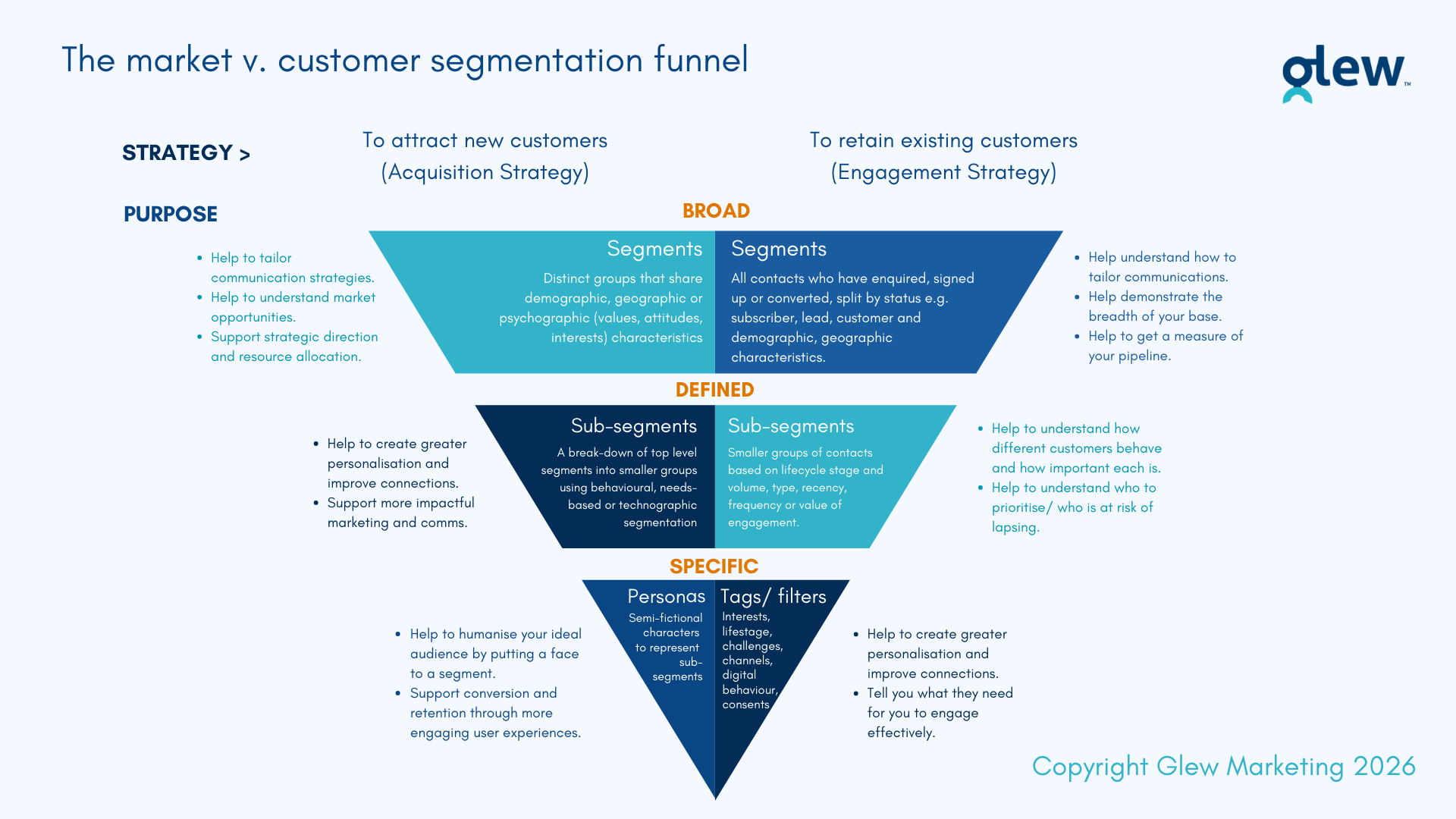
I find it useful to think of segmentation and the purposes of segments, sub-segments and personas as a funnel. The dual-funnel diagram below shows how these three components work across both pre-customer (acquisition) and post-customer (retention) marketing strategies.
Using segmentation to acquire new customers
The left‑hand side of the diagram shows how segmentation can be used to help you attract new customers.
Segments: Relate to people in the broader market – groups that share demographic or firmographic (the business equivalent), geographic or psychographic characteristics such as values, attitudes or interests.
Understanding which characteristics define your target audience will help you determine the size of the market opportunity for each segment, tailor high‑level communication strategies and guide your overall strategic direction and resource allocation.
Sub‑segments: Define the segments further, breaking them down according to needs or behaviour differences or by situational characteristics. For businesses, this could be their turnover or longevity; for consumers, it could be price sensitivity or digital maturity. Sub-segmenting helps you to focus in on the most impactful opportunities and provide greater personalisation to increase engagement.
Both segments and sub-segments are statistical in nature, designed to quantify and rationalise investment in marketing strategies.
Personas: Are more granular. They are semi‑fictional representations of your target sub-segments (often based on interviews) that are designed to bring them to life. They are more theoretical in nature and will often contain direct quotes which help teams and agencies to empathise with target audiences, design more engaging experiences and optimise messaging and tone to increase conversion. These characters can act as a memorable decision-tool e.g. when deciding whether to exhibit, simply asking ‘Is Bob going to be at this event?’ could help you save days and £1,000s. Personas are designed to be illustrative rather than a ‘catch-all’.
Using segmentation to retain existing customers
The right‑hand side of the diagram shows how segmentation can help you engage customers – or warm leads who have enquired or subscribed to your services – based on how they behave.
Segments: At the top of the retention funnel is your broad contact base, everyone who has – as a result of your acquisition strategy – made an enquiry, signed up to a newsletter, subscribed or converted. At the very least, you should be able to segment your contacts into subscribers, leads and customers to ensure you are not preaching to the converted. But as well as being able to tailor communications, segmenting our contacts can help you get a measure of pipeline health and breadth of customer base.
Sub‑segments: Sub-segmenting your customers according to their behaviour and value is where the real value comes though. By breaking them into smaller groups based on lifecycle stage and volume, type, recency, frequency or value of engagement, you can understand who the most valuable customers are, where there’s a risk of customer churn, and can in turn use those insights to improve the acquisition strategy.
Tags/ filters: Take things a step further. By considering other data, such as customer-provided preferences information or digital behaviour (via communications and webpages), you can develop a much more detailed picture of what customers need from you and how to most effectively engage them. This is where true personalisation really becomes possible
Three questions to get you started with segmentation
The strongest segmentations start with the following three questions:
1. Define the purpose
What decisions will segmentation help you to make?
Who to prioritise messages on in marketing? Who to focus on to increase conversion? Who to upsell/ cross-sell to? Who to send which email campaigns to?
Defining your use case for segmentation will ensure it’s not a redundant or ineffective exercise,
2. Define your pain point
What challenge will segmentation help you to solve?
Will it save you time chasing the wrong leads, increase your email engagement, help you understand which customers to reward with loyalty perks?
Understanding the cost of inaction will help to overcome any doubts about the time involved.
3. Think about what you already know
What can your customers tell you about your segments?
Are they in a handful of sectors? Do they share certain needs or demographics? Which customers tend to be the easier ones to service or upgrade?
This will give you a baseline to start defining your segments and sub-segments.
Segmentation is not about giving people labels
It is a valuable decision-making tool.
Segmenting for acquisition will help you decide who to attract and how to reach and convert them. Segmenting for engagement will help you decide who to prioritise and how to engage and retain them.
Not only that, it will help you set out a roadmap for which partnerships, processes and technology you need to implement, how to position yourself and what resources you’ll need to do it.
By starting broad, you will give your segmentation the top-level direction and by progressing it to the more specific you will allow your teams and agencies to be able to act on it.
We all have limited time and financial resource; segmentation is a powerful tool to ensure we optimise this.
If you’d like a chat about where to start, please book a free consultation with me today.