
‘Aligning marketing to business finances is not only accepted… it’s expected’
In an early role as an in-house marketer, I had no visibility of the organisation’s financial targets. They were considered irrelevant to my role. Even early on in my consultancy era, I remember a couple of clients being hesitant to provide financial figures initially.
Thankfully, things have evolved over the past 10-20 years and aligning marketing to business finances is not only considered acceptable, but commercially imperative. Still, there are many organisations setting SMART objectives at the tactical level but not connecting them to the overarching business objectives e.g. to increase turnover and market share.
This creates a lack of alignment making it hard to show the value of marketing, plan resources and defend or rationalise decisions. To explain, let’s look at an example using an objectives pyramid.
First, a quick note on objectives versus goals here. Objectives are tangible, numerical and short-term: SMART (specific, measurable, actionable, realistic and time-bound), whereas goals are long-term, less tangible and provide the general direction.
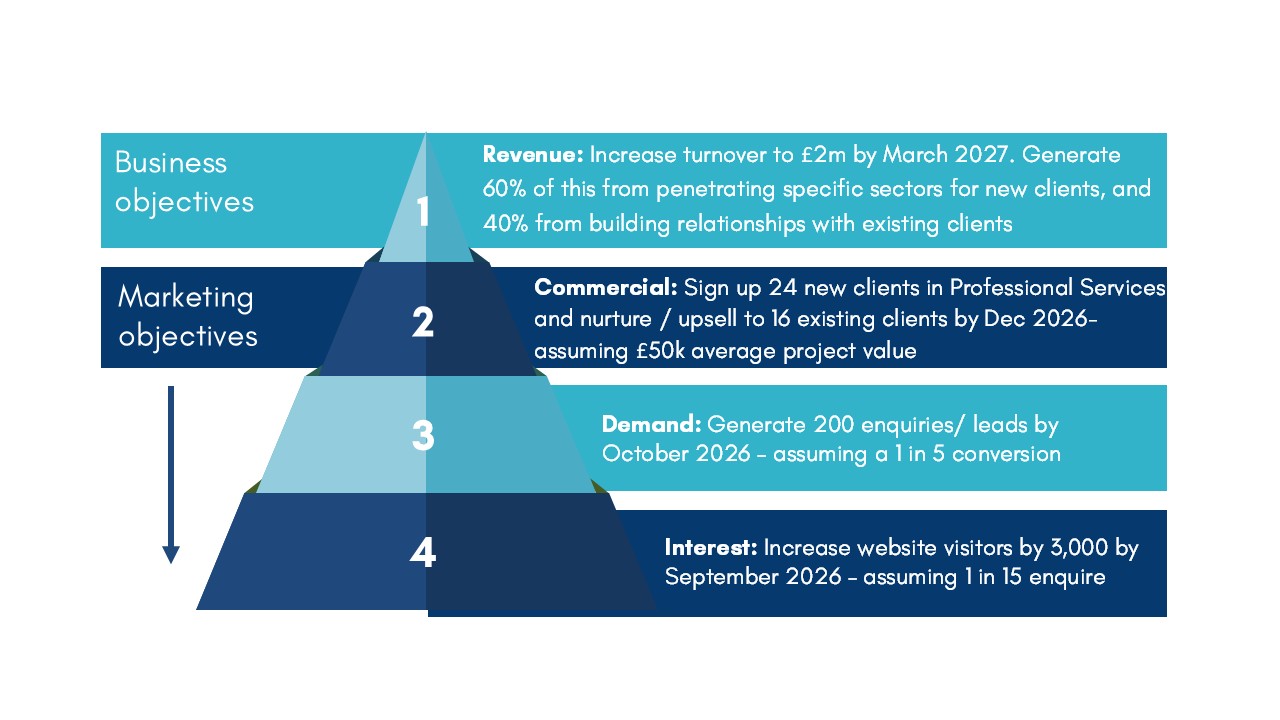
How to align marketing objectives to business objectives: a pyramid approach
1. First up is business objectives
These determine what the organisation as a whole wants to achieve. Business objectives might include increasing turnover or net profit, growing market share or launching into specific new markets.
In this example, if the business objective is to increase turnover to £2m by March 2027 which translates to: 60% (£1.2m) from new clients in priority sectors and 40% (£0.8m) from existing client growth, every marketing objective below should be designed to deliver this.
2. Sales and Commercial objectives
The business objectives should determine the volume and value of sales required. In this case, based on an average project value of £50k, the business would need to convert 24 new clients in target sectors and secure 16 upsells / renewals from existing clients.
£2m / £50k = 40 – 40 × 60% = 24 new clients – 40 x 40% = 16 existing clients
Other sales objectives might be around increasing average order value or shortening sales cycles.
3 & 4. Communication objectives
Communication objectives are usually focused on raising awareness, changing perceptions or generating qualified leads. For example, generating demand to achieve the commercial objectives.
In this example and based on an estimated conversion rate of 20%, the business would need to generate 200 qualified enquiries by October 2026.
200 enquiries × 20% conversion = 40 clients
Or an objective to increase awareness and interest: The enquiries will only happen if enough of the target audience is reached.
Assuming 1 in 15 visitors is likely to submit an enquiry, the business could set an objective to increase relevant website visitors by 3,000 by September 2026.
3,000 visitors x 20% conversion = 200 enquiries
If conversion rates prove higher or lower than assumed, the objectives will need to change to ensure they contribute the right level of activity to the overarching business objectives.
Starting at the top – but with the bottom line firmly in mind – ensures your marketing objectives support what the business actually needs. It also means you can more easily assign a financial value to each stage of the marketing funnel. See below for a rough value calculation (before costs).
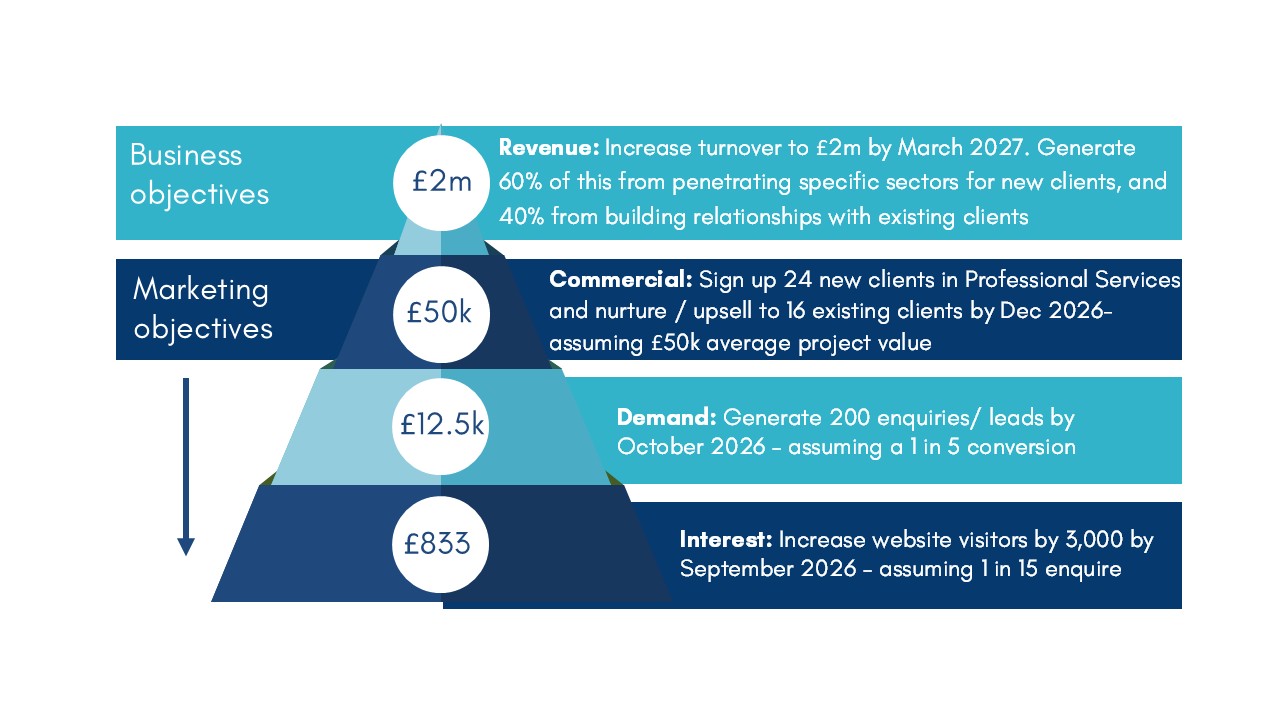
The benefits of aligning marketing objectives to business objectives
- By understanding the value of each engagement, you can set more realistic budgets to resource marketing and sales teams
- You can more easily communicate and rationalise marketing decisions
- You can identify which part of the process or marketing funnel is working well and which needs more attention
- You have a roadmap that states exactly how you’ll achieve your goals – this is not to say you won’t need to adapt it. For example, if conversion rates are higher or lower than you initially anticipated, you might need to tweak the figures.
Ultimately, by following a top-down objective-setting methodology to set SMART objectives for marketing and sales, you replace arbitrary with accuracy, laying a firm foundation to measure success.